
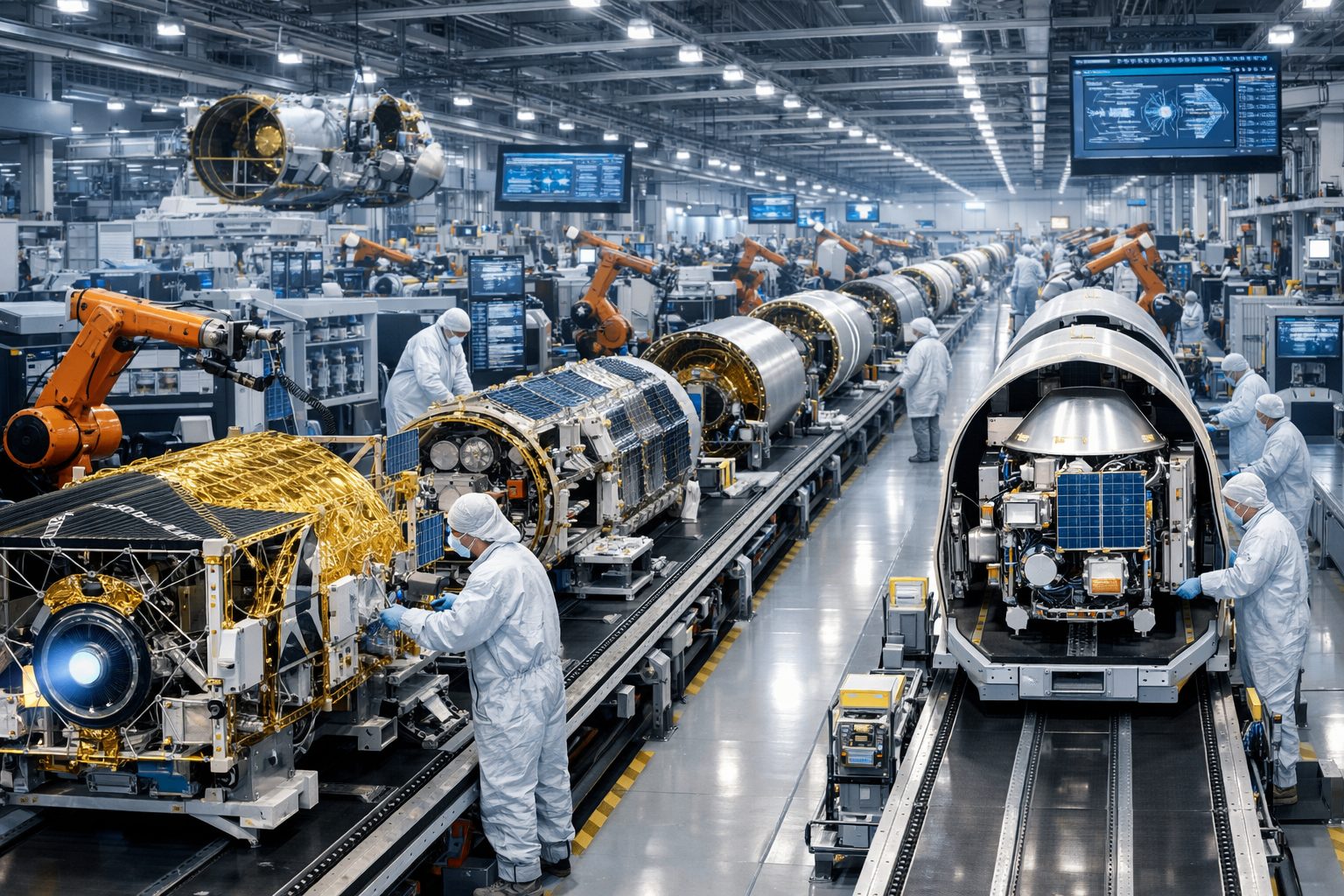
It usually starts the same way. You are in a room with smart people, looking at an aggressive production ramp, and someone asks a question that feels almost too obvious to ignore. If we can build millions of cars every year, why can't we build satellites, rockets, and engines at the same kind of rate?
It sounds reasonable. We have had more than a century to figure out manufacturing. Assembly lines, industrial engineering, process control. The playbook exists. So it is tempting to believe that space is just lagging, that with enough discipline and the right leaders, it will eventually catch up.
This belief holds until you step out of the conference room and into the actual system.
On the floor, the story feels different. Hardware is moving, but not in a smooth, continuous flow. Units advance, then stop. They wait. They queue. What looks like a production line is really something else entirely. It is a system that builds hardware and then immediately asks a harder question at every step along the way. Does it actually work?
In space, manufacturing and validation are inseparable. Every unit is not just assembled, it is proven. Satellites and subsystems are pushed through vibration, shock, thermal vacuum, electromagnetic interference, and RF validation. Not as a statistical sample, but as a requirement. Every single unit has to survive the environment it will face, because there is no fixing it once it leaves Earth.
At first, it is easy to conclude that test infrastructure must be the bottleneck. The chambers, the shakers, the specialized facilities. If those are limited, then of course production cannot scale. But if you spend enough time observing, something does not quite fit that explanation. There are moments when test equipment sits idle. Schedules have gaps. Capacity exists, at least on paper. And yet throughput does not increase.
This is where the system reveals its real constraint. Rather than test capacity in the static sense, it is test as a dynamic, variable system. It is the ability to move hardware through test successfully and predictably.
The System Constraint
When you look at it through a Theory of Constraints lens, everything starts to align. Test is the constraint, but not because there are too few chambers, but because it is where variability concentrates and where failure is most expensive.
A unit enters thermal vacuum with a small issue that was not visible earlier. The test takes longer than expected, or it fails late in the cycle. Now the schedule shifts. Downstream units wait. Upstream teams continue building, but what they produce cannot flow through the system. In some cases, hardware that was never truly ready for test consumes time in the most constrained part of the process, only to fail and re-enter the queue.
The result is a system that looks inconsistent from the outside. There are idle moments and periods of congestion, but overall throughput remains capped. Not because the system lacks capacity, but because it lacks predictability.
Throughput is ultimately governed by how many tests are completed successfully and how accurately their duration can be anticipated. When that predictability breaks, the entire system loses rhythm. And once you lose it, recovering it is expensive.
That is why the instinct to simply add more test capacity often falls short. If the underlying variability is not addressed, more chambers just create more places for the same problem to occur. The constraint does not disappear. It shifts or becomes harder to see.
The real leverage comes from protecting the constraint. Ensuring that only ready hardware enters test. Reducing variability upstream so that failures are caught earlier, when they are cheaper and less disruptive. Stabilizing test durations so that schedules can be trusted. In other words, treating test as the center of the production system. Even then, the challenge does not end there.
Bills of Materials are a Moving Target
High-rate manufacturing depends on stability, and space systems are rarely stable in the way automotive systems are. In automotive, designs repeat. Interfaces are fixed. Small changes are introduced carefully over time. That stability allows efficiency to compound.
In space, the design is still evolving. Each mission introduces new requirements, new environments, and new payloads. The bill of materials is not fixed. It moves with the mission. What you are building is not a single product repeated at scale, but a system that is still learning what it needs to be.
That reality shows up in supply chains that depend on specialized materials and limited vendors, in long-lead components, and in processes that rely heavily on expert judgment. It also shows up in design decisions. Many systems are still engineered for peak performance without fully accounting for how they will be built repeatedly. The result is hardware that works, but does not scale easily.
When you put all of this together, the original comparison to automotive starts to lose its meaning. Space manufacturing companies are operating a fundamentally different kind of system.
In automotive, validation has largely been separated from production. Integration is predictable assembly, and the line is designed to flow continuously. In space hardware production systems, validation is embedded. Integration is system-level verification under real conditions, and the system is designed to prove that each unit deserves to exist.
Scaling Throughput for Space Hardware Production Systems
Rather than forcing space into an automotive mold, we should think about redesigning space hardware production systems around their true constraints. Shifting validation earlier into design and simulation, creating more stable interfaces, and building production systems that explicitly manage variability instead of assuming it away.
When that begins to happen, throughput will increase. When this happens, we will be able to truly elevate and subordinate to constraints in space production systems and apply systems thinking to a system where manufacturing, validation, and integration have always been inseparable.
Once we see it that way, the original question changes from why space cannot build like automotive to how space, operating in harsh environments, imposes unique constraints on production systems, and how to design for high-rate manufacturing within those constraints.